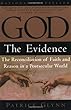
Many hard-core secularists pan this book --basically for not having proved its title. But, I think that criticism is unfortunate, and misdirected. Book titles often are the marketing creation of publishers, and not so much exactly what the author is trying to do.
In section one, this book attempts to explain in layman's terms the "anthropic principle", i.e. that our corner of the universe seems to be "just right" (as little red riding hood would say) for life -- what is called "fine-tuning" in popular parlance.
Subsequent sections proceed to describe the evidence of "near death experiences" (NDEs), and "out of body experiences" (OBEs), found --NOT in books of mystics, but-- in the vast catalog of professional medical journals.
So frequent are these phenomena, according to this author, that many long-term emergency medical people, and M.D.s, have come to believe that there is something very real to them. Whereas, academics tend to be more dismissive.
The author also discusses the work of professional psychiatrist, and popular author, M. Scott Peck --of "The Road Less Traveled" fame, which basically attempts to show that since Sigmund Freud (himself a maniacal atheist) the professional psychiatric and psychological community has not taken adequate account of the spiritual dimension of humanity.
This is unfortunate. Before Freud, and clinicalization, "psych-ology" (literally: "soul study") was a branch of philosophy. But, I digress.
Glynn goes on to bring together a concise summary of Peck's findings, and other medical journal evidence, which tends to show that people of faith recover more frequently from illness, and people of strongest faith recover more often still. Now, various people might draw different conclusions from that, but the conclusion that we are soulless machines seems the least likely of all.
The better conclusion the author (a former atheist -- now a Roman Catholic) thinks (and I think, also) is that God is real, and we are spiritual creatures.
This book is non_sectarian. It doesn't attempt to prove the Bible. It is more of a "natural law/natural theology" argument. Thus, it is one that Christian, Jew, and Muslim could affirm (even Hindu and Buddhist might enjoy it). This is because it makes no attempt to draw distinctions about why one religion is better than another. Its not a book about religion, as such. Though, I'm sure, the author in the right venue would probably say Christianity is best.
Rather, as I say, the book is about the spiritual dimension of humanity, and about people encountering that -- which encounters tend to lead many of us to a strong sense of the numinous. A theistic God, as traditionally understood, seems to be the best explanation of this sense of the numinous we humans have.
This book is a worthwhile and easy read, and will be fascinating to most who haven't been previously exposed to this kind of material. Not proof, but a interesting insight.

No comments:
Post a Comment