Sunday, April 8, 2012

Alive Again


But we see him who for a little while was made lower than the angels, namely Jesus, crowned with glory and honor because of the suffering of death, so that by the grace of God he might taste death for everyone.

For it was fitting that he, for whom and by whom all things exist, in bringing many sons to glory, should make the founder of their salvation perfect through suffering. Hebrews 2:9-10

...on the first day of the week, at early dawn, they went to the tomb, taking the spices they had prepared. And they found the stone rolled away from the tomb, but when they went in they did not find the body of the Lord Jesus. While they were perplexed about this, behold, two men stood by them in dazzling apparel. And as they were frightened and bowed their faces to the ground, the men said to them, “Why do you seek the living among the dead?

He is not here, but has risen. Remember how he told you, while he was still in Galilee, that the Son of Man must be delivered into the hands of sinful men and be crucified and on the third day rise.” And they remembered his words, and returning from the tomb they told all these things to the eleven and to all the rest. Luke 24:1-9

Tuesday, August 30, 2011

The Light of Life

Recently, pop diva Katy Perry won video of the year for her mildly surrealistic video anthem "Firework", a fantasy in which she insinuates a narcissistic solution into the minds of her viewers as an antidote to all of life's pains.

And that is, evidently, the reason that people suffer is because they haven't sufficiently broadcast their total selves to the world. Presumably, this full expression of themselves --a launching of "fireworks" for all to see-- will have the necessary therapeutic effect to get them out of the funk they are in. But, haven't we heard enough of the horror stories of the most over-exposed celebrities to doubt this sort of exhibitionism as any answer to life's trials?

Interestingly enough, about the same time Ms. Perry was releasing the "Firework" video, contemporary Christian band "The Afters" released their song & video "Light Up The Sky":


Similarly, the video has a number of situational images of people experiencing the various pains of life: losing a job, being informed of a terminal illness, the breaking up of a marriage. The Afters similarly use fireworks in their production toward the end of the video to give a dramatic effect to the implied message. But, the band points to another light source. And that is the divine light of God.

The difference in the message is quite profound. Katy points to human efforts to provide our own light in a dark world, with no reason to suppose (other than wishful thinking) that we can light our own path all alone. The Afters point to a light source external to us, and greater than us. A source which "lights up the sky", therefore can light the way for the world.

This general light is all around for those willing to see that there is a God who illumines His creation.

Psalm 19:1(NIV) says:
The heavens declare the glory of God;
the skies proclaim the work of his hands
.

And more specifically, God has given a concrete light to His prophets recorded for posterity in the Bible:

Psalm 119:130(NLT)
The teaching of your word gives light,
so even the simple can understand
.

Wednesday, June 29, 2011

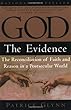
Book Review: "God: The Evidence"

"God:The Evidence: The Reconciliation of Faith and Reason in a Postsecular World," by Patrick Glynn

Many hard-core secularists pan this book --basically for not having proved its title. But, I think that criticism is unfortunate, and misdirected. Book titles often are the marketing creation of publishers, and not so much exactly what the author is trying to do.


In section one, this book attempts to explain in layman's terms the "anthropic principle", i.e. that our corner of the universe seems to be "just right" (as little red riding hood would say) for life -- what is called "fine-tuning" in popular parlance.

Subsequent sections proceed to describe the evidence of "near death experiences" (NDEs), and "out of body experiences" (OBEs), found --NOT in books of mystics, but-- in the vast catalog of professional medical journals.

So frequent are these phenomena, according to this author, that many long-term emergency medical people, and M.D.s, have come to believe that there is something very real to them. Whereas, academics tend to be more dismissive.

The author also discusses the work of professional psychiatrist, and popular author, M. Scott Peck --of "The Road Less Traveled" fame, which basically attempts to show that since Sigmund Freud (himself a maniacal atheist) the professional psychiatric and psychological community has not taken adequate account of the spiritual dimension of humanity.

This is unfortunate. Before Freud, and clinicalization, "psych-ology" (literally: "soul study") was a branch of philosophy. But, I digress.

Glynn goes on to bring together a concise summary of Peck's findings, and other medical journal evidence, which tends to show that people of faith recover more frequently from illness, and people of strongest faith recover more often still. Now, various people might draw different conclusions from that, but the conclusion that we are soulless machines seems the least likely of all.

The better conclusion the author (a former atheist -- now a Roman Catholic) thinks (and I think, also) is that God is real, and we are spiritual creatures.

This book is non_sectarian. It doesn't attempt to prove the Bible. It is more of a "natural law/natural theology" argument. Thus, it is one that Christian, Jew, and Muslim could affirm (even Hindu and Buddhist might enjoy it). This is because it makes no attempt to draw distinctions about why one religion is better than another. Its not a book about religion, as such. Though, I'm sure, the author in the right venue would probably say Christianity is best.

Rather, as I say, the book is about the spiritual dimension of humanity, and about people encountering that -- which encounters tend to lead many of us to a strong sense of the numinous. A theistic God, as traditionally understood, seems to be the best explanation of this sense of the numinous we humans have.

This book is a worthwhile and easy read, and will be fascinating to most who haven't been previously exposed to this kind of material. Not proof, but a interesting insight.

Salt and Light - Jami Smith